VILLAGE OF JOHNSON CITY, NEW YORK

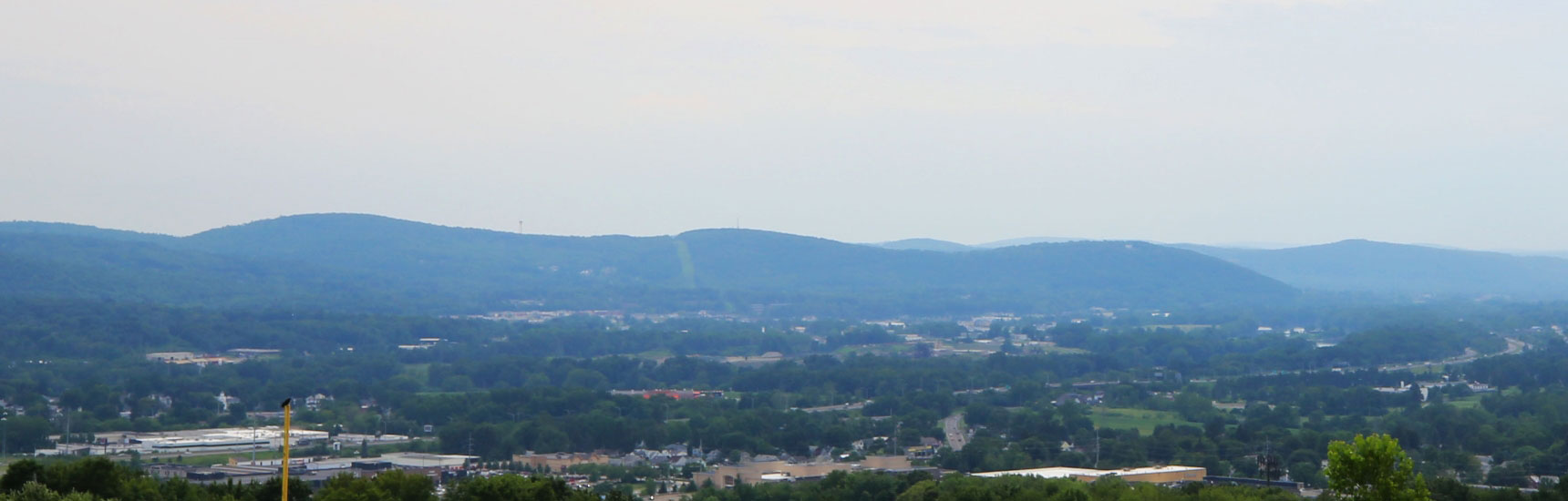
The Village of Johnson City is located in a beautiful valley at the center of the Triple Cities of the Southern Tier of New York. Binghamton is two miles to the east, and Endicott, the third of the Triple Cities is six miles to the West. Johnson City, at 4 1/2 square miles in area, is situated halfway between New York City & Buffalo, seventy miles south of Syracuse and sixty miles north of Scranton, PA. NYS Route 17 (future I-86) runs east-west through the Village.

HISTORY:

The recorded history of the Village of Johnson City begins long before its incorporation as a Village. In 1798 Mr. Samuel Allen, the first settler of what is now Johnson City, purchased approximately 400 acres of land at $11.00 an acre located in what is today central Johnson City. It was not until 1845 that a genuine homestead, occupied by the family of Lawrence Allen, son of Samuel Allen, was erected on the land.  Other early pioneering families included the Crockers, the Andrews, the Jennisons and the Brighams. The first business in the Village was a brickyard, established in 1854 by John Wells and Elijah Brigham.

Following the recommendation of George F. Johnson, a company employee, the Lester brothers decided to locate their new shoe factory down the river from Binghamton. In 1888 and 1889, they acquired sufficient acreage to lay out streets to form a proper Village and create lots available for homesites. In 1890, the Lester Brothers Boot & Shoe Company built the first shoe factory, 400 feet long, 50 feet wide and four stories high located along the D.L. & W. Railroad in what was to become the Village of Lestershire.

Incorporated on September 15, 1892, Lestershire’s population increased from 3,000 to 10,000 in the first 10 years.  Other business following the Lester brothers to the Village included a brush factory, Roberson’s Lumber Company and the 1900 Washer Company. The Lester brothers chose to focus their energies on the development of the homesites, causing the shoe company to suffer. Consequently, the company was taken over by Mr. Henry B. Endicott, a leather supplier and major company stockholder.  Mr. Endicott renamed the company the Lestershire Manufacturing Company and appointed George F. Johnson the General Superintendent.

In 1899, using $150,000 borrowed from Mr. Endicott, George F. Johnson purchased half of the company and the Endicott-Johnson Corporation was formed. The company and its owners founded a library, built parks and housing for its workers and helped electrify Main Street. The company also provided medical care for its workers and their families. George F.’s brothers Harry L. and C. Fred played important roles in the development of the Village. Harry L. Johnson was instrumental in forming fair labor polices at the factory. C. Fred Johnson, a pioneer in organized fire prevention practices, fathered the Village’s paid professional Fire Department. Charles F. Johnson, Jr. developed recreation centers and established a pension for Endicott-Johnson employees. At the height of its growth, Endicott-Johnson employed 20,000 people in the area. Unfortunately, the last Endicott-Johnson manufacturing facility, built in 1945, closed in 1993.   The Village still has many landmarks related to the Endicott-Johnson Company.

It was this practice of paternalism that formed the basis for Johnson’s “industrial democracy.” This legacy of fair treatment of workers and community outreach and investment made the area vibrant. It was George F. Johnson’s “Square Deal” hiring practices that made Johnson City the “Home of the Square Deal.”

On March 21, 1916, the Village of Lestershire was renamed Village of Johnson City to honor George F. Johnson and his family.

Annexations have played an important part in Johnson City’s history. The first came in 1918, the second in 1922, the third in 1936 and the fourth and largest, the Oakdale Annexation, in 1962 which increased the size of the Village by almost a third. The Oakdale area was the sight of Bigler’s Mill, which provided the 60-foot beam of white oak that became the keel of the ironclad “Monitor” of Civil War fame.

The decade of the 1960’s was a time of tremendous change in the Village. In 1963, the Charles S. Wilson Memorial Hospital constructed its twin towers.  In 1967, the construction of NYS Route 17 (future I-86) cut through the Village from east to west. To make way for the highway, many homes were demolished along with the area’s minor league ballpark, Johnson Field. Johnson Field was the home of the Triplets, a minor league club of the NY Yankees. Area baseball fans saw some of the game’s most famous players at this field, including Joe DiMaggio, Babe Ruth and Lou Gehrig.

The construction of Route 17 was an important part in the development of the Village in the 1970’s and 1980’s. Comprising some 900,000 square feet of floor space, the Oakdale Mall, the first regional shopping center in Broome County, was constructed off one of the Village’s interchanges. The success of the Oakdale Mall lead to other developments in that area of the Village including the Giant Oakdale Plaza, the Johnson City Plaza, Toys R Us, Wegmans Supermarket and the construction of four hotels. Although the importance of Endicott-Johnson to the region has declined, this decline has led to an increased diversity of industrial activities. Several small electronics firms are located in the industrial heart of Johnson City and other retailing activities are scattered throughout the Village and its historic downtown.  These shops serve primarily as neighborhood shopping centers, satisfying local needs. The Village’s central location and proximity to a good transportation network make it invaluable as a distribution and storage location.

The growth in the Oakdale area included the construction of a new high school in 1970, four apartment complexes and countless residential homes. In the 1980’s, the hospital expanded again, adding the Decker Building and the Wilson Square Office Building. The hospital was renamed the “Wilson Memorial Regional Medical Center” to reflect its position as a major regional hospital. As technology & medical care continue to advance, the hospital is constantly expanding and upgrading its facilities.

In the 1990’s, the Village experienced another surge of growth with the development of the Carpathian Hill project, which included the construction of office buildings, the home of WBNG-TV, the Highlands Senior Housing and numerous residential lots.

History of Endicott-Johnson

Story of George F. Johnson


SCHOOLS:

The Johnson City Central School District was formed during the 1960’s from nine districts covering all of the Village and parts of three other municipalities. With small class sizes, and a positive learning environment, students have achieved impressive success. Over 70% of the students pursue higher education, and SAT scores are well above the state and national averages. This record is well received by parents with 98% of them rating the district as outstanding. Johnson City schools have received national recognition for their fine arts programs. 5 times since 1999, the National Academy of Recording Arts & Sciences Foundation, Inc., selected the high school’s music program as a Grammy Signature School, recognizing the program as one of the most comprehensive high school programs in the United States. The JCHS Music Program was selected as a 2010 Finalist for the GRAMMY Signature School. Johnson Cityis the only public school in America to have received this award 6 times. In 2003, 2004, 2009, 2010, 2011 & 2012 the school district was named one of the “100 best communities for music education” by the American Music Conference and the National Association for Music Education. In September of 2003 the school district announced a partnership with the Anderson Center for the Performing Arts at Binghamton University and the Kennedy Center for the Performing Arts as part of the Kennedy Center’s Partners in Education Program.

In addition, the district has a national reputation for excellence. In his book, “The Quality School”, Dr. William Glasser stated that, “The Johnson City Schools are probably the best model in the United States of what could be called quality schools.”

The school district is currently assessing its needs for the next century. Construction of a new state of the art school to house the district’s kindergarten through 8th grade students was completed in the fall of 2003.

RECREATION:

Johnson City is served by 5 major parks, and 5 smaller parks and playgrounds. Considering the size of the Village, these parks are accessible to all. Softball, basketball, and tennis are popular activities among the residents, and the major parks have facilities for these. Two swimming/wading pools exist that are aimed at providing entertainment for pre-adolescent children. The Recreation Department, in conjunction with the school district, coordinates an extensive summer-winter recreation program.

The Village has an independent senior citizens center with a current enrollment of some 1200 persons. Activities range from card games to vacation trips that are organized through the center.

The Village is the proud home to the “Crown Jewel” of Broome County’s unique collection of six wooden carousels donated by the George F. Johnson family in the 1920′s. One of the largest remaining carousels in the country, it contains 4 rows of 72 horses. In 1993 the horses, scenic panels & rounding boards were completely restored returning them to their original beauty. In 2010 the eighteen sided, two story pavilion and cupola housing the carousel was restored. Located in CJF Park,  the carousel has been run free of charge since its installation. This is another powerful legacy of the Johnson family.

THE FUTURE:

Johnson City looks to the future with a great sense of optimism. Construction of the George Korutz Justice Building, a state of the art Police Station and Court Facility Building was completed in late 2002. The redevelopment of the Goodwill Theater and the establishment of an Arts Center will bolster the revitalization of the central business district. The redevelopment of the Endicott-Johnson factory sites will provide great hope and expectations for many years.

POPULATION OF THE VILLAGE OF JOHNSON CITY:

According to the 2010 Census – 15,174


Comments are closed.